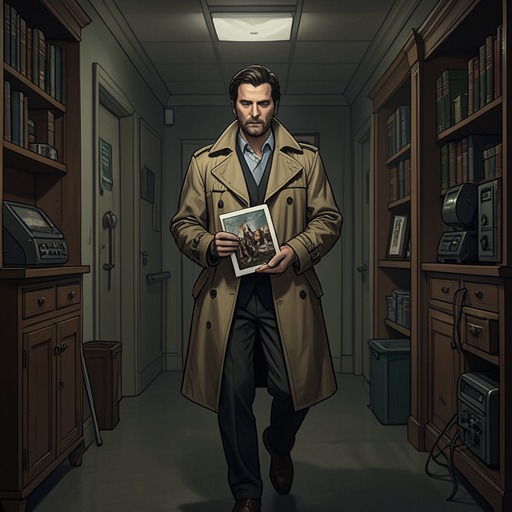
Attempted murder of Mickey Haller at Fryman Canyon
The Brass VerdictThe Attempted murder of Mickey Haller at Fryman Canyon turns a quiet stop at an overlook into a confrontation on the edge of a precipice. A masked man approaches Haller with a gun and tries to force him over the drop; a shot from elsewhere interrupts the assault, and law enforcement arrives. The attacker is then unmasked and identified as juror number seven, a man who had failed to appear at trial and was being sought by the Sheriff’s Department. The scene links immediate physical danger to the unresolved mystery surrounding the absent juror, without establishing why he attacked Haller or who fired the intervening shot.
Background and Immediate Circumstances
Before the attack, Haller receives a call about Lanie Ross. A caller reports finding her on Mulholland Drive, says she should not be driving, and explains that she passed out after handing over Haller’s card. Haller takes the report as confirmation of his fear that she has relapsed. He worries that an arrest could return her to the system and lead to another stay in jail and rehabilitation, then asks which jail she is being taken to. The call gives the episode a second urgent concern: while Haller is trying to understand what has happened to Lanie, the danger facing him is already close.
At the overlook, Haller parks and gets out. The Valley stretches below the clearing, and Harry Bosch is present with him. Haller begins to say that he has to go and try to find someone, but the account does not complete the thought. The interrupted sentence leaves the immediate purpose of his departure unfinished; the next movement he notices is a crouching figure emerging from brush beside the parking area. The location’s openness does not make Haller safe: the brush provides the attacker’s approach, while the precipice gives the assault its immediate threat.
The Attack and Intervention
The approaching man is dressed in black and wears a ski mask. Haller first mistakes the movement at the edge of his vision for a coyote, then recognizes a person raising a gun. He drops his phone and lifts his hands. The attacker closes the distance, shoves him backward, and grabs the collar of his jacket to make him get up. Haller’s questions do not slow the encounter; the man dismisses them and continues to control where Haller moves.
The assault becomes an attempt to drive Haller off the steep edge. He tries to resist by digging in his heels, but the effort brings a harder shove and leaves him moving toward the drop. His thought of falling into a backyard hot tub after a three-hundred-foot plunge registers the danger in the blunt, practical terms of someone who sees how little space remains. The scene’s central reversal comes not from a negotiation or a successful escape, but from a shot fired from the right and at a distance. Almost at the same moment, a metallic snapping sound comes from behind Haller; the masked man cries out and falls into the brush. The account does not identify the shooter or explain the sound, so neither can be confidently assigned to a particular person or weapon.
Haller dives face down at the edge and covers his head as shouting, running, and vehicles moving over gravel fill the clearing. Blue lights flash across the dirt and brush. Their arrival changes the immediate balance of the scene: Haller, moments earlier under the attacker’s control, is told he can get up. Harry Bosch is standing above him, and Haller’s response that Bosch cut it close underscores how narrowly the danger has passed. Several officers in black windbreakers move through the area; some wear LAPD raid jackets, while most have FBI markings. A helicopter’s spotlight then illuminates the clearing, broadening the response from a sudden intervention into a coordinated law-enforcement presence.
Identification and Significance
The man in the mask is cuffed and complains that his hand is broken. When the mask is removed and a flashlight is directed at his face, Haller recognizes him as juror number seven from the trial. Bosch responds with confusion, and Haller explains the identification: the juror had not appeared that day, and the Sheriff’s Department was looking for him. The reveal changes the meaning of the attack. The assailant is not merely an unknown armed man encountered at an isolated overlook; he is connected to the trial and to the unexplained disappearance of one of its jurors.
That connection makes the rescue a consequential turn in the juror mystery, but not a complete explanation of it. The evidence establishes the attacker’s identity and his absence from court, while leaving his reason for confronting Haller unstated. It likewise records a distant shot and a metallic snap without naming the person responsible. By ending on Haller’s recognition of the masked man, the episode replaces one unanswered question—who is attacking him?—with a more pointed one about the missing juror’s role. The attack’s immediate outcome is Haller’s survival and the man’s restraint; its larger consequence is that the absent juror becomes a concrete figure in the danger surrounding the trial.